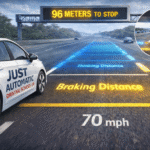
If you are transitioning from a manual car or are a complete beginner, learning how to drive automatic transmission car is your easiest route to road independence. Automatic cars eliminate the clutch and gear shift, simplifying the driving experience dramatically. This comprehensive automatic car driving guide for beginners will walk you through everything from understanding the key gear settings (P, R, N, D) to mastering the two-pedal system, ensuring you can safely and confidently take your first drive.
Step 1: Understanding the Automatic Transmission Gear Selector
The first critical step is mastering the different modes (gears) available on your automatic selector. Unlike manual, you don’t shift constantly; you select the mode for the task.
Decoding PRND: The Essential Automatic Gear Modes
You must understand the function of each letter before starting the engine:
P (Park): Locks the transmission, preventing the wheels from turning. Always use this when parked.
R (Reverse): Engages reverse gear. Used for backing up.
N (Neutral): Disengages the transmission. Used for brief stops (e.g., in a car wash) or when pushing the car, but never for general driving.
D (Drive): The primary driving gear. The car automatically shifts through all forward gears for general travel.
L (Low) or S (Sport)/Other Numbers: Some cars have these for specific situations. ‘L’ or numbers (1, 2) lock the car into lower gears for climbing steep hills or engine braking on long descents.
The Golden Rule: Always Use the Brake to Shift
A key safety rule when learning how to drive automatic transmission car is that you must always have your foot firmly on the brake pedal before moving the selector out of ‘P’ or ‘N’. This prevents the car from lunging forward unexpectedly.
Step 2: Mastering the Two-Pedal System (Brake vs. Accelerator)
The automatic car features only two pedals, making proper foot positioning crucial for safety. This is a fundamental part of the automatic car driving guide for beginners.
The ‘Left Foot Rule’: Why You Only Use Your Right Foot
Automatic cars are designed to be driven using only your right foot for both the brake pedal and the accelerator pedal.
The Danger: Using the left foot for the brake is extremely dangerous because it can lead to accidental simultaneous pressing of both pedals (causing a crash) or panic braking, which is a common beginner mistake.
The Technique: Position your left foot on the floor’s dead pedal (footrest) for stability, and use your right foot to pivot between the brake and the accelerator.
Understanding the ‘Creep’ Feature of Automatic Cars
Automatic cars have a natural tendency to ‘creep’ (move slowly forward) when the selector is in ‘D’ or ‘R’ and your foot is off the brake (even if you aren’t pressing the accelerator). Mastering the brake for low-speed control is essential.
Step 3: Driving the Automatic Car (Starting, Stopping, and Parking)
Starting the Car Safely (The Ignition Sequence)
Ensure the gear selector is in ‘P’ (Park).
Press the brake pedal firmly with your right foot.
Turn the ignition key or press the start button.
Keep the brake pressed, move the selector to ‘D’ (Drive).
Check your mirrors and blind spots, release the handbrake, and slowly lift your foot off the brake to initiate the ‘creep’.
Seamless Stopping and Coasting Control
When slowing down, take your foot entirely off the accelerator and cover the brake pedal. Use the brake to smoothly slow the car. For a full stop (e.g., at a red light), firmly press the brake until stationary. Do not shift to ‘N’ unless waiting for a prolonged time; simply hold the car in ‘D’ with the brake.
Parking the Automatic Car (The P-N-Handbrake Sequence)
To safely park an automatic car and avoid straining the transmission:
Come to a complete stop and hold the footbrake.
Shift the selector into ‘N’ (Neutral).
Engage the handbrake (parking brake).
Release the footbrake to allow the weight of the car to settle onto the handbrake.
Re-engage the footbrake and shift the selector into ‘P’ (Park).
Step 4: Essential Safety Tips and Next Steps
Driving an automatic is simple, but driving safely requires disciplined habits.
The Golden Safety Triangle: Observation, Road Position, and Speed
Because the mechanics are simplified, the examiner expects flawless execution of the safety triangle:
Observation: Constant use of mirrors and effective blind spot checks.
Road Position: Accurate lane placement and following distance.
Speed: Correctly matching speed to the environment and road limits.
Learning how to drive automatic transmission car requires focusing on these over physical control.
Why Professional Lessons Accelerate Your Confidence
While this guide covers the basics, a professional ADI will teach you defensive driving, hazard perception, and how to safely execute manoeuvres in real-world traffic. For those serious about passing their test quickly, booking a structured course is highly recommended. You can confidently explore our range of courses to learn to drive automatic fast and get on the road safely.
Ready to Master Your Automatic Car? Book an Introductory Lesson
Knowing the theory is one thing; putting it into practice is another. The best way to implement this automatic car driving guide for beginners is with a professional instructor. For those based in the Midlands, our expert automatic instructors in Birmingham are ready to guide you step-by-step.