Understanding braking distance at 70 mph is vital for motorway driving safety and is a mandatory part of the DVSA theory test. At high speeds, the slightest misjudgment can lead to a severe accident. This comprehensive guide breaks down the official stopping distance at 70 mph based on the highway code braking distance formula, explains the exponential danger of braking distance on ice, and details the critical safety factors needed to manage your vehicle at maximum UK speed limits.
The Official Formula Understanding Stopping Distance at 70 mph
The total distance your car travels before stopping is the sum of two key components.
Defining Thinking Distance and Driver Reaction Time
Thinking Distance is the distance your car travels from the moment you see a hazard to the moment you apply the brakes.
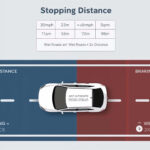
70 mph Calculation: The official thinking distance at 70 mph is approximately 21 meters (69 feet). This is entirely dependent on driver reaction time (the average is 0.67 to 1 second).
Key Factor: Factors like fatigue, mobile phone usage, or driving anxiety on motorways significantly delay your reaction time, directly increasing this distance.
Defining Braking Distance and The 70 mph Exponential Risk
Braking Distance is the distance your car travels from the moment the brakes are applied to the car coming to a stop.
70 mph Calculation: The official braking distance at 70 mph is approximately 75 meters (246 feet).
Exponential Risk: Doubling your speed from 35 mph to 70 mph quadruples your braking distance. This exponential increase is why 70 mph driving is so high-risk.
The Total Stopping Distance at 70 mph (The Highway Code Figure)
The total official stopping distance at 70 mph is 96 meters (315 feet), roughly the length of three football pitches. This is the test critical knowledge required for all UK driving tests.
Critical Safety Factors Affecting Braking Distance
Braking distance is not fixed; it is highly dependent on environmental and vehicle conditions.
The Ultimate Danger Braking Distance on Ice and Wet Roads
Wet Road Stopping Distance: The braking distance on wet roads can double due to the film of water causing hydroplaning and reduced tyre grip.
Vehicle Performance Tyres, Weight, and ABS
Poor tyre tread depth and incorrect tyre pressure drastically reduce your car’s ability to stop. A heavily loaded vehicle requires more stopping power. Modern systems like ABS (Anti-lock Braking System) and ESC (Electronic Stability Control) significantly reduce the chance of skidding but do not change the braking distance formula itself.
Advanced Training How Automatic Lessons Reduce Thinking Time
Learning in an automatic car removes the mental load of clutch and gear management. This focused approach frees up crucial milliseconds of driver reaction time, allowing you to apply the brakes faster. This is why many learners choose structured automatic intensive courses to build muscle memory quickly.
Advanced Techniques Mastering 70 mph Motorway Safety
Effective motorway driving at 70 mph is all about preemptive action and gap management.
The 3-Second Rule Maintaining a Safe Following Distance
At 70 mph, you must maintain a minimum three-second time gap in dry conditions (not two seconds). In rain or poor visibility, this gap should be increased to four or five seconds. This safe following distance is your only buffer against the long stopping distance at 70 mph.
Preemptive Braking and Driver Alertness
Practice preemptive braking lifting your foot off the accelerator and covering the brake as soon as you see a potential hazard (e.g., brake lights two cars ahead). This simple act eliminates your thinking distance and immediately begins the stopping process, a hallmark of an expert driver.
Local Expertise for Test Critical Knowledge
Even if you are not tested on the motorway, understanding these high-speed principles is key. Training with Birmingham automatic instructors will teach you the safest practices for approaching and merging onto high-speed dual carriageways, managing high-risk scenarios and driver alertness.
Securing Your Safety and Knowledge
Expert Support Mastering Test Critical Knowledge
Understanding the braking distance formula is not just for the test; it is for lifelong safety. Seek expert guidance from an automatic driving training provider to master the physics and psychology of safe stopping.
Contact Us for Advanced Driving Tips
Don’t leave your safety to chance. Contact us for a safety consultation and tailored practical sessions to master all aspects of safe braking and high-speed driving.