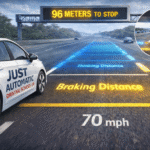
Understanding the difference between braking distance stopping distance is one of the most fundamental requirements of safe driving and essential test critical knowledge. The total distance your car travels from the moment you see a hazard to the moment you stop is not just about the brakes; it involves thinking distance and braking distance. This comprehensive guide breaks down the official highway code stopping distances, explains the formula, details the critical factors that increase this distance, and shows how training with automatic driving experts can reduce your driver reaction time.
Understanding the Formula: Thinking Distance + Braking Distance
The total distance your vehicle travels before coming to a complete stop is called the stopping distance.
Defining Thinking Distance and Driver Reaction Time
Thinking Distance is the distance your car travels from the moment you see a hazard to the moment you apply the brakes.
Key Factor: This distance is primarily determined by the driver reaction time. Factors like fatigue, distraction, alcohol, or illness significantly increase your thinking distance.
Speed Impact: Thinking distance increases directly in proportion to your speed. For example, your thinking distance at 60 mph is twice that at 30 mph.
Defining Braking Distance and Vehicle Factors
Braking Distance is the distance your car travels from the moment you apply the brakes to the moment the car comes to a stop.
Key Factors: This distance is primarily determined by vehicle factors (tyre tread, ABS brakes, vehicle weight) and road conditions (wet, dry, icy).
Speed Impact: Braking distance increases exponentially with speed. Doubling your speed (e.g., from 30 to 60 mph) quadruples your braking distance.
The Highway Code Stopping Distances Table Explained
The official highway code stopping distances provide a critical benchmark:
30 mph stopping distance: 75 feet (23 metres)
50 mph stopping distance: 175 feet (53 metres)
70 mph stopping distance: 315 feet (96 metres)
This table highlights the severe increase in stopping distance at higher speeds, making it vital test critical knowledge for all learners.
Critical Safety Factors That Increase Stopping Distance
Various road conditions and driver states dramatically increase the total distance required for a safe stop.
The Effect of Wet Roads and Icy Conditions on Braking Distance
Wet Road Stopping Distance: In wet conditions, the braking distance can double. The water acts as a lubricant between the tyre and the road surface, reducing friction.
Driver Factors Impairment and Fatigue
Driver reaction time is the most volatile variable. Fatigue, mobile phone usage (distraction), and any form of impairment immediately increase your thinking distance, which is often the cause of rear-end collisions. Training with Birmingham driving instructors focuses heavily on recognizing and mitigating these risks.
Vehicle Maintenance Tyres and Load
Poor tyre tread depth and under-inflated tyres drastically reduce your ability to grip the road, directly increasing the braking distance. Similarly, a heavily loaded vehicle requires more force and time to stop due to increased momentum.
Advanced Learning How Training Reduces Your Stopping Distance
While the physics of braking distance are fixed, structured training can significantly reduce your thinking distance.
The Automatic Driving Advantage for Reaction Time
Learning in an automatic car removes the mental load of managing the clutch and gears. This frees up crucial milliseconds of driver reaction time, allowing you to identify a hazard and apply the brakes faster. This focused training method is why many choose automatic driving training provider lessons.
Mock Tests and Hazard Perception Practice
Dedicated practice for the Hazard Perception Test (HPT) trains your brain to identify potential dangers much earlier. During mock tests, you practice acting on those hazards immediately, turning recognition into an immediate braking response. Learners on an intensive crash course often show the quickest improvement in HPT scores.
Advanced Training for Safety Structured Automatic Courses
Advanced training focuses on preemptive action. Enrolling in structured automatic courses (like those offered by Just Automatic Driving School UK) trains you to maintain a greater following distance and anticipate hazards, which effectively reduces the likelihood of having to use your maximum stopping distance.
Mastering This Test Critical Knowledge
Final Expert Support Secure Your Driving Knowledge
Understanding braking distance stopping distance is not just for the test; it is for lifelong safety. Seek expert guidance to master the physics and psychology of safe stopping.
Contact Us for Advanced Driving Tips
Don’t leave your safety to chance. Contact us for advanced driving tips and tailored practical sessions to master all aspects of safe braking and hazard perception.