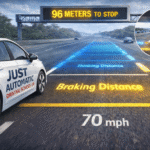
Traffic jams are arguably the most stressful part of driving. If you’ve chosen an automatic car, you’ve already made the smartest move, as the clutch and gear work are eliminated. However, driving smoothly and safely in stop-start traffic still requires technique. This comprehensive guide on how to drive automatic car in traffic jam will teach you the essential skills, from mastering the ‘creep’ to maintaining the safest following distance, ensuring you can tackle even the heaviest driving automatic in heavy traffic with confidence and ease.
The Automatic Advantage in Stop-Start Traffic
The automatic car is uniquely designed to handle the low-speed, constant movement of a traffic jam better than any manual car.
The Power of the ‘Creep’ Function (The Biggest Advantage)
The ‘creep’ function is the automatic car’s superpower in a traffic jam. When the gear selector is in ‘D’ (Drive) and your foot is off the brake, the car slowly moves forward without touching the accelerator.
Mastering the Two-Foot Technique (Not Recommended for Beginners)
While experts only use the right foot, some experienced drivers in stop-start traffic use a specific technique:
Right Foot: Dedicated to the accelerator.
Left Foot: Dedicated to the brake.
WARNING: This technique is NOT taught or recommended by ADIs for learners or new drivers, as it drastically increases the risk of a crash due to panic braking. Always stick to the right foot only rule for maximum safety.
Say Goodbye to Roll Back on Hill Starts
One of the biggest anxieties in manual driving (especially in traffic on a hill) is the risk of rolling backwards. In an automatic car, once you lift the brake, the car will either hold its position or creep forward, eliminating roll-back and removing a major source of traffic jam stress.
Pro Techniques for Smooth and Safe Traffic Jam Driving
Effective driving in a traffic jam is all about precise control and defensive positioning.
1. The Two-Second (Four-Second) Rule in Heavy Traffic
The number one safety technique in driving automatic in heavy traffic is managing the space in front of your car.
Slow-Moving Traffic: Aim for a two second gap between your car and the car in front.
Stop-Start Traffic: Aim for the car in front’s tyres and tarmac to be visible. This ensures you have enough room to manoeuvre or stop if they suddenly reverse, and it prevents you from constantly creeping forward.
2. ‘Dwell Time’ Management: Foot Off the Brake When Stopped
Holding the footbrake constantly can be tiring and annoying for the driver behind you.
Short Stops (Creep): Use the footbrake to hold the car.
Long Stops (Over 10 seconds): Engage the Handbrake/Parking Brake. This gives your foot a rest and signals clearly to the driver behind you that you are stationary. Do not shift to ‘P’ unless the stop is very long and you turn the engine off.
3. The Power of Anticipation (Eyes Up, Not Down)
In a traffic jam, do not look only at the car directly in front of you. Always look two or three cars ahead. This allows you to anticipate braking or movement, enabling you to use the brake pedal more gradually and make your car’s movement smoother a hallmark of excellent automatic driving.
4. Lane Filtering and Side Scanning
Be extra vigilant for motorcycles, cyclists, and mopeds ‘lane filtering’ (moving between lanes). In slow traffic, they are often moving faster than you. Regular side scanning (checking side mirrors) is crucial before moving even an inch laterally to avoid causing an accident. Local automatic driving instructors can provide specific guidance on this in your area.
Advanced Controls and Maintenance
Using ‘L’ or ‘S’ Modes in Specific Conditions
Most automatic cars have modes beyond ‘P, R, N, D’ that can be useful in specific traffic or road conditions:
‘L’ (Low) or 1/2: Locks the car into a lower gear. Useful for very steep, slow inclines in traffic where you need maximum engine torque.
‘S’ (Sport): Increases responsiveness and higher revs. Generally not recommended for a traffic jam as it can make the car too ‘jumpy’.
Transmission Care: Avoiding Costly Damage
Driving an automatic car improperly in a traffic jam can lead to expensive damage:
Avoid Shifting to ‘N’: Constantly shifting between ‘N’ and ‘D’ at short stops causes unnecessary wear and tear on the transmission’s bands and clutches. Keep it in ‘D’ and use the footbrake/handbrake.
Transmission Heat: Continuous slow-speed operation can increase transmission fluid heat. Modern cars manage this well, but smooth driving reduces stress.
Learn Traffic Techniques with Expert Guidance
The best way to master how to drive automatic car in traffic jam is through professional training. Structured automatic courses often include dedicated lessons focused on urban and heavy traffic driving, turning this stressful experience into an easy routine.
The team at Just Automatic Driving School specialises in these real-world driving techniques. We teach you how to use the ‘creep’ function to your maximum advantage.
Ready to Drive Stress-Free? Book Your Traffic Skills Session
Stop fearing the traffic lights! Gain the confidence to drive smoothly in any city environment. Book your advanced automatic lesson today to learn these techniques firsthand and conquer your traffic anxiety. For your next step, get your personal pass hour estimate now!