

Pass Your Driving Test in a Week: The Real Fast Track Strategy and 7-Day Roadmap
Home » Pass Your Driving Test in a Week?
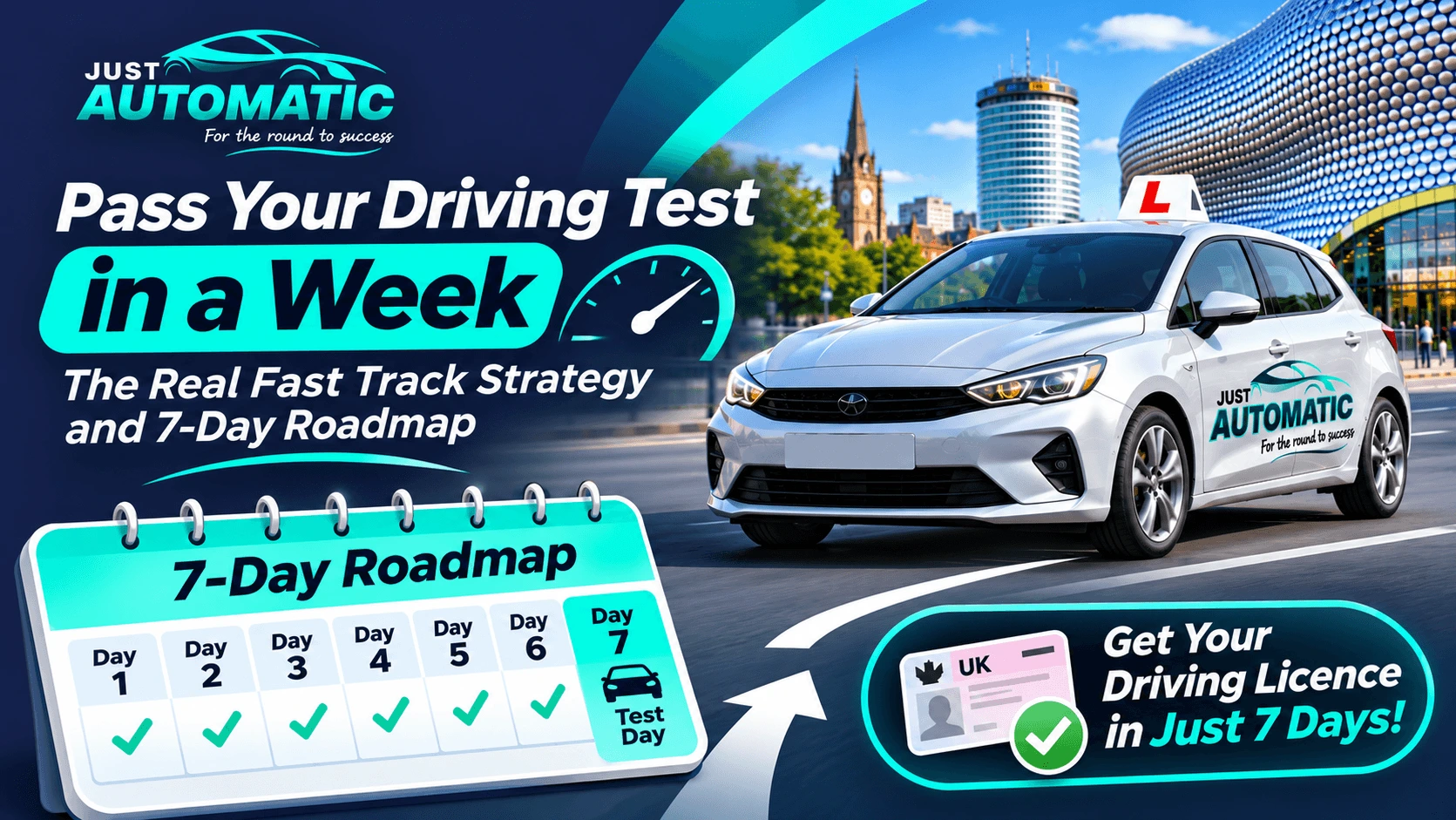


The absolute fastest way to pass your driving test in a week is by booking a 40-hour intensive course spaced over 7 consecutive days, but you must have already passed your theory test to secure a practical exam slot for the final day. However, severe mental fatigue, choosing a manual car, and failing to secure a short-notice test date cause thousands of ambitious learners to fail their one-week challenge. In this comprehensive fast-track guide, we break down the exact day-by-day 40-hour schedule, reveal why automatic cars are the secret to passing in seven days, and show you how to beat the DVSA waiting lists to secure your driving licence in record time.
The desire to learn to drive in a week is a common and exciting goal, particularly for university students on break or professionals needing a licence for a new career.
While possible for highly dedicated candidates, it requires intense physical stamina, an airtight strategic plan, and world-class professional guidance.
The Feasibility Check: Can You Really Pass in Just 7 Days?
The possibility of passing from scratch in one week depends entirely on your preparation, physical stamina, and the logistical alignment of the test date.
The Ideal Candidate Who Can Realistically Pass in a Week
Achieving a quick pass driving test in 7 days is not a magic trick; it is a high-pressure athletic event for your brain. It is only realistic for learners who meet these strict criteria:
Passed Theory Test (Mandatory): Your valid DVSA Theory Test pass certificate must be in your hand before you attempt to book a one-week course. You cannot book a practical test without it.
Prior Experience: Having significant previous driving experience (e.g., recently failed a test, held an overseas licence, or completed substantial private off-road practice) drastically cuts down the hours needed for basic car control.
High Aptitude & Stamina: You must possess a natural ability for coordination and excellent concentration to handle 5 to 7 hours of intense daily driving without suffering mental burnout.
The Hours Needed: Why 40 Hours in 7 Days is Non-Negotiable
To reach the DVSA’s stringent test-ready standard in a single week, you need to condense the national average of 45 hours of training into 7 days. This means enduring an intense schedule of six hours of driving per day for six consecutive days, plus a final warm-up on day seven.
Skill Retention Factor: The concentrated nature of the training maximizes skill retention, which is the only reason this hyper-compressed timeframe is feasible.
The Zero Hour Myth: Anyone claiming you can pass in under 20 hours as an absolute beginner is setting unrealistic expectations and risking an expensive failure.
The Ultimate Requirement: The Test Date Guarantee
The biggest logistical hurdle is securing a test date that aligns perfectly with the seventh day of your course.
Only a reputable school with access to cancellation slots can realistically achieve this. Always partner with a certified automatic driving school in the UK to ensure your training structure is sound and your test slot is confirmed before you pay.
The Fast Pass Strategy: 5 Crucial Steps to Your Licence in Days
To achieve a one-week pass, you must prioritize time-critical steps and ruthlessly eliminate all common time-wasting activities.
Step 1: The Pre-Assessment to Eliminate Wasted Hours
Before paying for any intensive course, you must take a professional two-hour assessment lesson.
This ensures you purchase the exact number of hours you need. It also provides a skill-gap analysis, allowing your instructor to prepare a laser-focused training plan that avoids wasting paid time on skills you have already mastered.
Step 2: Immediate Test Booking After the Theory Pass
Do not wait. The moment you pass using the official DVSA theory test booking portal, you must book your practical test (even if the date is months away) or rely on a driving school’s ability to secure a short-notice test. For the fastest possible route, consider structured fast-track intensive courses which often include dedicated test slots. (Internal Link to /intensive-driving-course)
Step 3: Localized Practice for Maximum Efficiency
Your training must be 100% focused on the official test routes. Training with experts who provide automatic driving lessons around Birmingham ensures you know every complex junction, multi-lane roundabout, and potential fail-point in your test area. This localized familiarity is essential for eliminating test-day anxiety.
Step 4: The 7-Day Routine of Maximum Consolidation
Your one-week routine must be strictly regimented: 35 hours for instruction and a minimum of 5 hours for mock tests and test-day car hire.
This leaves zero room for error or burnout. You must ensure you are well-rested, eating healthily, and reviewing the Highway Code each evening to maximize the return on your expensive daily training.
Step 5: Final Mock Tests to Eliminate Simple Faults
Your last 5 hours must be dedicated entirely to mock tests under strict exam conditions. These simulated tests, which mimic the examiner’s silent route directions and pressure, are the only way to eliminate simple faults (e.g., poor blind spot checks, rushed mirror routines) that account for 80% of test failures.
The Complete Day-By-Day 7-Day Driving Course Roadmap
For an absolute beginner attempting to learn to drive in a week, this is the exact grueling but effective 40-hour daily schedule required:
| Training Day | Daily Hours | Core Driving Skills Mastered | Primary Learning Goal |
| Day 1: The Basics | 6 Hours | Cockpit drill, moving off, stopping, basic steering, T-junctions | Master complete vehicle control on quiet residential roads. |
| Day 2: Traffic & Flow | 6 Hours | Emerging into major roads, approaching roundabouts, pedestrian crossings | Integrate the Mirror-Signal-Manoeuvre (MSM) routine flawlessly. |
| Day 3: Speed & Space | 6 Hours | Dual carriageways, slip roads, meeting traffic in narrow lanes | Overcome high-speed anxiety and manage safe following distances. |
| Day 4: Manoeuvres | 6 Hours | Parallel parking, bay parking (forward and reverse), pulling up on the right | Execute all official DVSA test manoeuvres with perfect observation. |
| Day 5: Independence | 6 Hours | Following sat-nav directions, navigating complex spiral roundabouts | Drive for 20 minutes independently without instructor prompts. |
| Day 6: Mock Testing | 6 Hours | Full 40-minute simulated driving tests under strict exam conditions | Identify and eliminate serious driving faults under pressure. |
| Day 7: Test Day | 4 Hours | Final warm-up drive, Show Me Tell Me questions, Official Practical Test | Manage nerves, drive safely, and secure your pass certificate! |
Choosing Automatic Transmission to Guarantee a One-Week Pass
If you are committed to the 7-day challenge, learning in an automatic vehicle is the single smartest strategic decision you can make.
Zero Clutch Anxiety and Stalling Prevention
Manual learners dedicate 10 to 15 hours of their course purely to clutch control, finding the biting point, and preventing stalling on hill starts. Automatic drivers skip this entire mechanical learning curve. By eliminating gear coordination, your mental capacity is freed up to concentrate 100% on junction observation and hazard perception—the actual skills examiners assess.
Which Package Should You Book: The 5-Day vs 7-Day Course
5-Day Course (25-30 Hours): Only suitable for learners with prior experience. It relies heavily on high natural aptitude and pre-existing car control skills.
7-Day Course (40+ Hours): The most comprehensive dedicated 7-day crash course packages. This option minimizes risk for a first-timer aiming for the ultimate pass your driving test in a week goal by providing the full DVSA recommended hours.
Addressing the Post-Test Skill Gap
A common drawback of passing fast is the post-test skill gap—a lack of experience in varied weather (heavy rain, snow) or night-time driving. It is highly recommended to book a Pass Plus course or post-licence training to build confidence in these areas immediately after passing.
Beating the DVSA Waiting List for a Short-Notice Test
You cannot pass in a week if you cannot secure a test date.
The Automated Cancellation System
With standard DVSA waiting times stretching to four or five months, you must utilize the official DVSA driving test cancellation service daily. If you manage to secure a short-notice cancellation date yourself, you can take advantage of our short-notice driving test vehicle hire to secure dual-control car hire and pre-test warm-up coaching.
Next Steps to Secure Your One Week Training Plan
The path to passing in a week is entirely achievable with the right strategy, physical stamina, and a top-tier driving school. Stop researching “pass your driving test in a week” and take definitive action.
You can review all our transparent intensive lesson prices to budget correctly. When you are ready to commit, request your fast-track assessment lesson now to check availability and secure your fast-track path to passing!
- Just Automatic Driving School
- December 21, 2025


Just Automatic Driving School
Just Automatic Driving School UK is the leading automatic driving specialist serving Birmingham and the wider Midlands area. We offer highly structured automatic driving courses and reliable driving lessons Birmingham. From absolute beginner lessons to advanced Intensive Driving Courses, our experienced Birmingham driving instructors ensure you gain the skills needed to pass first time. Choose your trusted Birmingham driving school for excellence in automatic training.
Connect with US



Frequently Asked Questions About the Provisional Licence
Is the pass rate higher for a one-week intensive driving course?
Yes. Reputable schools that rigorously pre-assess their students often report a significantly higher pass rate than the national average. This is primarily because the concentrated learning ensures peak muscle memory and performance on test day.
What is the biggest risk of trying to pass your test in a week?
The absolute biggest risk is burnout and mental fatigue. Driving for 6 hours daily can lead to severe drops in concentration during the final lessons, which frequently causes simple, avoidable mistakes on the actual test.
What is the actual shortest time a complete beginner can pass their test in?
The absolute shortest realistic time for a completely new beginner is usually 10 to 14 days. This allows for 40 hours of instruction spread slightly to include some essential mental recovery time between intensive sessions. A strict 7-day pass for an absolute beginner is an exception, not the rule.
Does the Theory Test certificate need to be valid for the entire week of the course?
Yes. Your Theory Test certificate must be legally valid on the exact day of your practical test, which is the final day of your course. If it expires before the final day, the DVSA will not allow you to take the test.
If I fail, how long is the waiting list for a retest after a quick pass course?
The waiting list for a standard retest can stretch to several months. This is why a premium driving school will often include a short-notice retest option in its package to maintain the momentum of the quick pass process.
Can I still use my instructor's car if I fail the first test?
Yes, provided you pay the car hire fee again. Your instructor will also require you to book a short block of remedial lessons (usually 4 to 6 hours) to fix the major fault that caused the failure before allowing you to hire the car for the retest.