

How Stopping Distances Change in Rain Snow and Icy Weather on UK Roads
Home » Stopping Distance in Rain & Ice: UK Highway Code

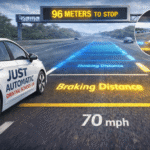


According to the official Highway Code, your total stopping distance in rain doubles compared to dry tarmac, while on snow and ice, your stopping distance can multiply by up to ten times, turning a standard 30 mph stop into the length of more than two football pitches. However, misjudging surface grip, failing to adjust following distances, and panicking during a skid cause thousands of winter collisions and theory test failures across the UK each year. In this comprehensive road safety guide, we break down the exact speed-by-speed stopping distance matrix, explain the physics of aquaplaning and black ice, reveal how modern ABS responds on low-grip surfaces, and teach you how to maintain total vehicle control in severe British weather.
Maintaining safe separation distances is the most fundamental defensive driving skill tested by the Driver and Vehicle Standards Agency (DVSA).
Understanding the mathematical relationship between vehicle speed, road moisture, and tyre friction is essential for passing your theory exam and protecting your licence in real-world driving conditions.
The Fundamental Physics of Stopping Distances in Adverse Conditions
Total stopping distance is calculated by adding thinking distance (the distance travelled while recognizing a hazard and reacting) to braking distance (the physical distance travelled after depressing the brake pedal until the vehicle comes to a complete halt).
While thinking distance is primarily determined by driver alertness, adverse weather dramatically multiplies the physical braking distance.
Why Braking Distance Doubles on Wet Tarmac and Standing Water
When rain falls on asphalt, water mixes with accumulated engine oils, road dust, and loose rubber debris to create a slick surface film:
Reduced Friction Coefficient: On dry tarmac, clean rubber tyres maintain high grip against the textured aggregate of the road. On wet roads, water fills the micro-grooves of the road surface, cutting tyre friction in half.
The Braking Multiplier: Because friction is halved, the mechanical work required by your brake pads and tyres to arrest the vehicle’s kinetic energy takes twice as long. At 60 mph, your braking distance expands from 45 metres on dry tarmac to roughly 90 metres in wet weather.
The Importance of Planning: Because you cannot change the laws of physics, drivers must identify hazards twice as far ahead. Enrolling in structured automatic driving programs trains your eyes to look further down the carriageway to anticipate decelerations early.
Why Icy Road Conditions Multiply Your Stopping Distance by Ten
The question how much can stopping distance increase in icy conditions is one of the most frequently asked questions on the DVSA theory test, and the answer is an astonishing ten times.
Zero Surface Texture: When water freezes into ice or compacted snow, the road texture is completely covered by a frictionless sheet.
The Physics of Ice Friction: Under freezing conditions, the micro-layer of moisture created by tyre pressure acts as a liquid lubricant between the rubber and the ice. The tyres cannot bite into the road surface.
Catastrophic Distances: A vehicle travelling at just 30 mph requires an astonishing 230 metres (754 feet) to come to a complete stop on ice, compared to just 23 metres on a dry summer day. This is greater than the length of two full-sized Premier League football pitches, proving that high speed on ice makes safe braking physically impossible.
The Threat of Aquaplaning and How Tyre Tread Depth Protects Grip
Aquaplaning (also known as hydroplaning) occurs when your vehicle’s tyres completely lose contact with the tarmac and ride on a pressurized film of water:
How Aquaplaning Happens: At speeds above 45 to 50 mph, standing water cannot escape through the tyre grooves quickly enough. Water builds up as a wedge in front of the tyre, lifting the rubber off the road. When aquaplaning occurs, your steering wheel feels alarmingly light and completely unresponsive, and braking has zero effect.
The Role of Tyre Tread: UK law requires a minimum tyre tread depth of 1.6 mm across the central three-quarters of the tyre. However, in heavy rain, a tyre with 1.6 mm of tread takes significantly longer to clear water than a healthy tyre with 3 mm or more. Tyres with deep grooves channel gallons of water away from the contact patch every second, delaying the onset of aquaplaning.
Comprehensive Highway Code Stopping Distance Table for Rain and Ice
Under official Highway Code stopping distances rule 126, the DVSA publishes baseline stopping distances for dry conditions. Review this expanded comparative table to understand how rain and ice radically alter your vehicle’s stopping trajectory:
| Vehicle Speed | Thinking Distance | Dry Road Total Distance | Wet Road Total Distance (x2) | Icy Road Total Distance (x10) |
| 20 mph | 6 Metres (20 ft) | 12 Metres (40 ft) | 24 Metres (80 ft) | 120 Metres (394 ft) |
| 30 mph | 9 Metres (30 ft) | 23 Metres (75 ft) | 46 Metres (150 ft) | 230 Metres (754 ft) |
| 40 mph | 12 Metres (40 ft) | 36 Metres (118 ft) | 72 Metres (236 ft) | 360 Metres (1,180 ft) |
| 50 mph | 15 Metres (50 ft) | 53 Metres (175 ft) | 106 Metres (350 ft) | 530 Metres (1,750 ft) |
| 60 mph | 18 Metres (60 ft) | 73 Metres (240 ft) | 146 Metres (480 ft) | 730 Metres (2,400 ft) |
| 70 mph | 21 Metres (70 ft) | 96 Metres (315 ft) | 192 Metres (630 ft) | 960 Metres (3,150 ft) |
Note: In freezing conditions, braking distances expand exponentially. At 70 mph on black ice, your car would travel nearly one full kilometre before stopping. You can explore our transparent driving lesson rates and packages to learn how structured adverse weather training is scheduled into our tuition.
Vehicle Technology and Driving Techniques for Bad Weather Control
Modern cars are packed with electronic stability systems, but driver technique remains the ultimate deciding factor in preventing collisions.
How Anti Lock Braking Systems Respond on Slippery Road Surfaces
Anti-lock Braking Systems (ABS) are standard equipment on all modern passenger cars:
The Function of ABS: ABS uses wheel-speed sensors to detect when a tyre is about to lock up and skid during emergency braking. The system automatically pulses the brakes dozens of times per second, preventing the wheels from locking.
The Steering Benefit: The primary advantage of ABS is not that it stops the car faster; it is that by keeping the wheels rotating, it allows you to continue steering around an obstacle while applying maximum brake pressure.
The ABS Limitation on Ice: On solid ice or loose gravel, ABS can actually increase your stopping distance slightly because the system constantly releases braking pressure to keep the wheels rotating on a surface where zero grip exists. ABS cannot create traction where none is present.
Using Gentle Accelerator Feathering in an Automatic Vehicle
Driving an automatic car provides a decisive safety advantage during hazardous winter weather:
Eliminating Clutch Jerk: Manual drivers frequently break wheel traction by dropping the clutch too abruptly on icy roads, causing immediate wheelspin or engine stall. In an automatic car, power delivery is silky smooth.
Feathering the Throttle: When accelerating on packed snow or icy residential streets, you can gently feather the accelerator pedal, allowing the automatic transmission to deliver smooth, incremental torque to the drive wheels without breaking traction.
Creep Control in Traffic: You can use the car’s natural idle creep to move forward slowly in traffic queues without touching the accelerator pedal at all, maintaining total vehicle composure. Choosing to learn to drive in an automatic eliminates mechanical shifting anxieties, leaving your complete mental focus for hazard avoidance.
The Four Second Rule for Safe Following Distances in the Rain
The standard Highway Code guideline for dry roads is the two-second rule (measuring the time between the car ahead passing a stationary roadside object like a bridge and your vehicle reaching that same object) :
Double the Gap in Wet Weather: Because stopping distance in rain doubles, you must extend your following distance to at least four seconds.
The Twenty Second Rule on Snow and Ice: When navigating snowy roads, rural lanes, or freezing motorways, you should expand your following gap to an astonishing twenty seconds. This massive cushion provides the physical space required to bring your car to a controlled, gentle stop without triggering an uncontrolled skid.
Common Theory Test Questions and Dangerous Practical Driving Faults
Adverse weather scenarios are heavily featured on DVSA examinations, and failing to adapt to weather conditions is an immediate reason for test failure.
Answering Official DVSA Theory Exam Weather Calculations
Examiners frequently test your knowledge of weather-related distance changes:
Question Type 1: “You are driving in heavy rain. What is the minimum time gap you should leave between your car and the vehicle ahead?” (Answer: At least four seconds).
Question Type 2: “In which conditions will your stopping distance increase by up to ten times?” (Answer: On icy road surfaces).
Question Type 3: “What should you do if your steering suddenly feels light while driving on a wet motorway?” (Answer: Do not brake sharply; ease your foot off the accelerator smoothly until the tyres regain road grip).
Avoiding Severe Tailgating and Inadequate Separation on Dual Carriageways
On the practical driving test, failing to maintain a safe following distance in wet weather is recorded as a Serious or Dangerous driving fault:
The Examiner’s Perspective: If it begins to rain during your 40-minute driving test and you continue driving two car lengths behind the vehicle ahead at 50 mph, your examiner will record a serious fault for following distance.
The Correct Action: The moment rainfall begins or road spray kicks up, you must deliberately ease off the throttle and allow a generous four-second gap to form between you and the traffic ahead.
Handling Low Winter Sun and Blinding Roadway Surface Spray
Winter driving introduces optical hazards that directly multiply your thinking distance:
Low Winter Glare: In mid-winter, the sun sits low on the horizon, creating blinding glare reflected off wet road surfaces. Keep your windscreen spotless inside and out, use your sun visors, and carry clean polarized sunglasses in your vehicle.
Surface Spray from Commercial Lorries: Heavy articulated lorries generate dense spray clouds on high-speed dual carriageways. Increase your following gap substantially before attempting an overtake, and ensure your windscreen wipers are operating at maximum speed before entering the spray plume. Motorists returning to driving after a long break can book post-licence refresher courses to rebuild their foul-weather driving confidence.
Developing All Weather Road Confidence with Professional In Car Coaching
Reading stopping distance tables gives you theoretical knowledge, but mastering adverse weather control requires hands-on coaching on real roads.
Adverse Weather Navigation Across the West Midlands
Driving across the West Midlands during winter demands familiarity with unique local road layouts and challenging terrain:
Coventry Ring Road in Heavy Rain: Managing high-speed weaving, short slip road entries, and standing water along elevated flyovers. Learners taking learner tuition across Coventry receive dedicated instruction on managing spray, gap selection, and lane discipline under heavy metropolitan traffic.
Solihull Rural and Suburban Roads: Navigating unlit country lanes toward Earlswood and Hockley Heath where surface flooding, fallen wet leaves, and black ice frequently catch out newly qualified drivers. Working with certified Solihull driving school instructors equips students with the advanced anticipation needed to read concealed road conditions safely.
The Value of Professional All Weather Training
At Just Automatic Driving School UK, our DVSA-approved instructors do not cancel lessons when rain falls or temperatures drop. We actively embrace inclement weather as an invaluable teaching environment.
You will learn how to test your brakes safely on quiet roads, operate demisters and fog lights instinctively, and adjust your road speed to match official Met Office severe weather driving advice.
Learning how to control an automatic vehicle on wet and frosty roads ensures you never feel trapped indoors when British weather turns severe.
Scheduling an Advanced Inclement Weather Session with Our Team
Gaining your full UK driving licence means earning the right to drive safely in any weather condition, from blazing summer sunshine to torrential winter downpours.
Do not let fear of wet motorways or icy roundabouts hold back your driving independence.
Take the definitive step toward total driving confidence. You can enquire about driving lessons with our friendly, experienced automatic instructors today and build the lifelong vehicle control skills that protect you and your passengers on every journey!
- Just Automatic Driving School
- November 8, 2026

Just Automatic Driving School
Just Automatic Driving School UK is the leading automatic driving specialist serving Birmingham and the wider Midlands area. We offer highly structured automatic driving courses and reliable driving lessons Birmingham. From absolute beginner lessons to advanced Intensive Driving Courses, our experienced Birmingham driving instructors ensure you gain the skills needed to pass first time. Choose your trusted Birmingham driving school for excellence in automatic training.
Connect with US



Frequently Asked Questions About the Pass Plus Scheme
How much can stopping distance increase in icy conditions?
According to the official Highway Code, your stopping distance can increase by up to ten times on icy road surfaces compared to dry conditions. At 30 mph, this extends your stopping distance from 23 metres to approximately 230 metres .
What is the recommended following distance when driving in heavy rain?
You should leave a minimum of a four-second time gap between your car and the vehicle in front when driving in wet weather, effectively doubling the standard two-second rule used for dry conditions.
What should I do if my car starts aquaplaning on a wet road?
If your steering feels light and your car begins to aquaplane, do not brake sharply and do not make sudden steering wheel movements. Ease your foot gently off the accelerator and keep the steering wheel straight until the tyres cut through the water and regain contact with the road.
Does having ABS reduce my stopping distance on ice?
No. Anti-lock Braking Systems (ABS) prevent your wheels from locking, which allows you to continue steering while braking. However, on solid ice or snow, ABS cannot create traction where none exists, and in some situations, it can slightly increase the overall stopping distance.
What are the minimum legal tyre tread depth requirements in the UK?
The legal minimum tyre tread depth for passenger cars in the UK is 1.6 mm across the central three-quarters of the tyre tread around the entire circumference. However, safety organizations strongly recommend replacing tyres when they reach 3 mm to maintain effective water clearing in heavy rain.
In which conditions will your stopping distance increase the most?
Your stopping distance increases the most on ice and compacted snow, where braking distances expand by up to ten times. Other conditions that increase stopping distance include heavy rain, loose gravel, mud on rural lanes, driving with worn tyres, and vehicle overloading.